

FC’s decision in Ketua Pengarah Dalam Negeri (IRB) v Kind Action (M) Sdn Bhd (KASB) [2025] CLJU 539 reinforces an important principle in Malaysian tax law: tax authorities must act consistently and cannot impose double taxation by disregarding their own previous assessments without proper justification.
What Happened?
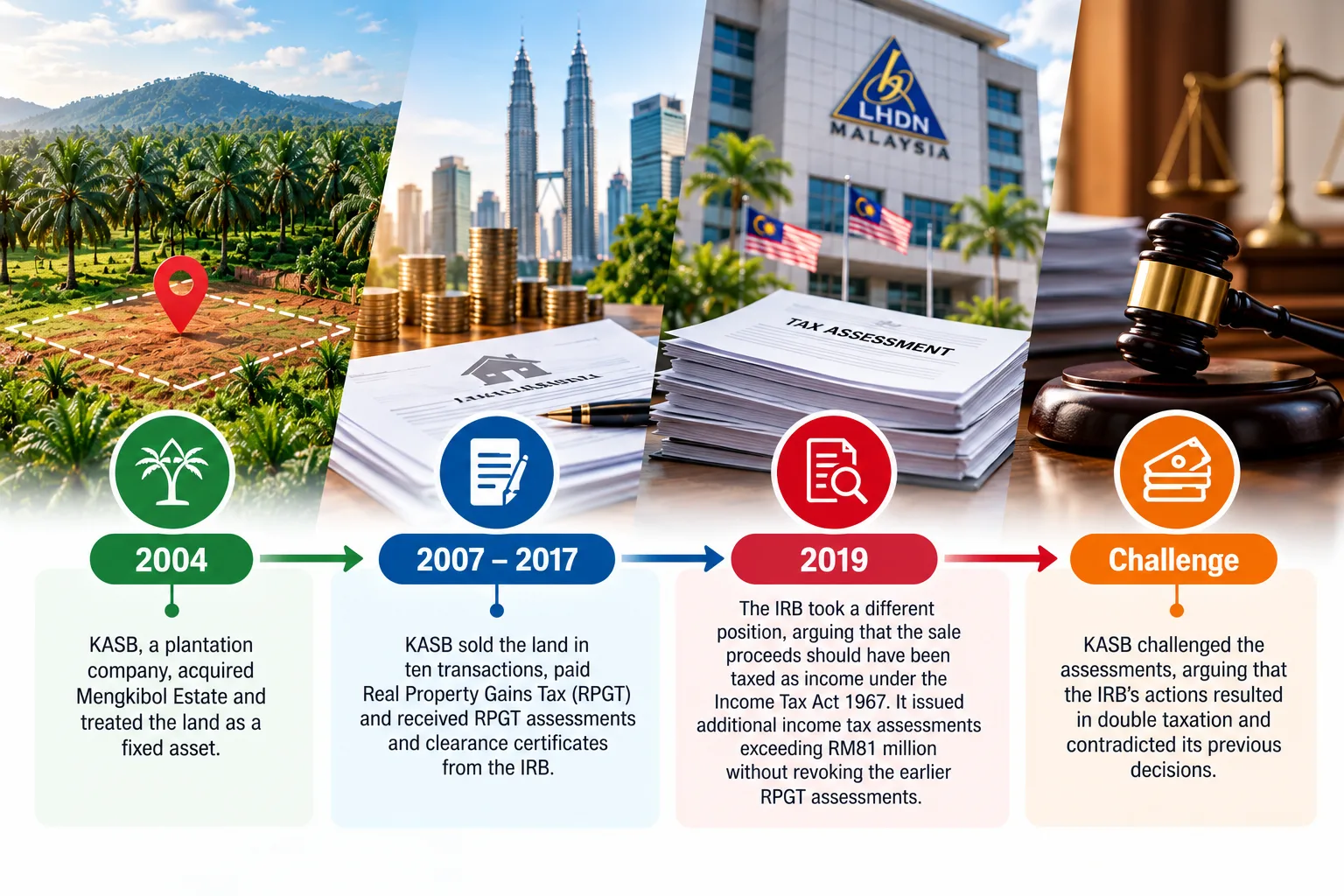
KASB, a plantation company, acquired Mengkibol Estate in 2004 and consistently treated the land as a fixed asset. Between 2007 and 2017, it sold the land in ten transactions, paid Real Property Gains Tax (RPGT) and received RPGT assessments and clearance certificates from the Inland Revenue Board (IRB).
However, in 2019, the IRB took a different position, arguing that the sale proceeds should have been taxed as income under the Income Tax Act 1967 rather than as capital gains under the Real Property Gains Tax Act 1976. It subsequently issued additional income tax assessments exceeding RM81 million without revoking the earlier RPGT assessments.
KASB challenged the assessments, arguing that the IRB’s actions resulted in double taxation and contradicted its previous decisions.
What Did the Courts Decide?
High Court dismissed KASB’s application, holding that the Special Commissioners of Income Tax should address the dispute. Court of Appeal overturned that decision, finding that the IRB’s failure to revoke the earlier RPGT assessments before imposing income tax resulted in unlawful double taxation.
FC upheld Court of Appeal’s decision, emphasising the finality of RPGT assessments under Section 20(1) of the Real Property Gains Tax Act 1976. It also recognised that the IRB’s repeated assessments and clearances had created a legitimate expectation that the transactions would not be taxed again under the Income Tax Act.

Key Legal Principles
Estoppel: A party may be prevented from contradicting its previous conduct or representations where another party has relied on them. In this case, the IRB’s earlier assessments and clearances were central to the Court’s decision.
Legitimate Expectation: Public authorities should act fairly and consistently when their conduct creates a reasonable expectation of particular treatment. Unexplained changes in position may be open to legal challenge.
Why Does This Matter to SMEs?
The decision underscores that tax authorities’ powers are not unlimited. Taxpayers may challenge inconsistent tax treatment, particularly where official assessments have been issued and the same transactions are subsequently subjected to additional taxation. For SMEs, the case highlights the importance of retaining tax assessments, clearance certificates and supporting records. These documents may be significant when disputing subsequent assessments.
Takeaway: Tax compliance is not merely about paying the correct tax. It also requires fair, consistent and lawful treatment by the tax authorities.